Products
Membranes & processes
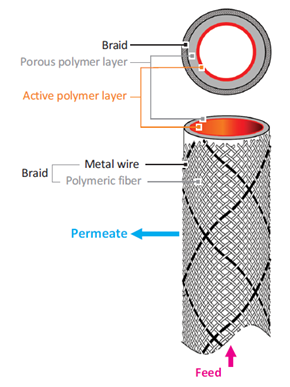
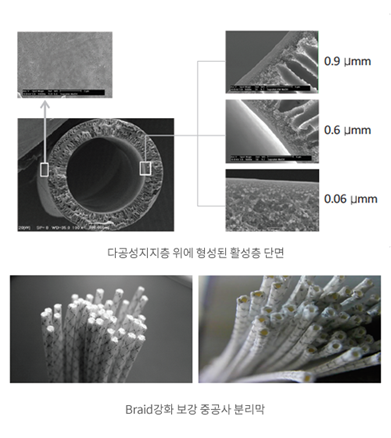
Pervaporation membrane process is a membrane separation process that can separate liquid/liquid mixtures, while Vapor permeation membrane process is a membrane separation process that can separate vapor/vapor or vapor/gas mixtures. These two membrane separation processes differ only in the shape of feed mixture to be separated, but they are the same membrane process, using a non-porous polymer membrane. The hollow fiber type pervaporation/vapor permeation membranes are reinforced by a braid of polyester, which have been developed by SepraTek's new technology. A hollow fiber form of pervaporation/vapor permeation composite membranes utilizes the significant benefits of hollow fiber membrane shape; high membrane packing density in module, low fabrication cost, and flexibility in membrane module design, so that the hollow fiber membranes can be applied in various fields. SepraTek™ hollow fiber composite membranes consist of a braid structure of reinforcement, a porous support layer, and an active layer on the porous layer. The braid fabrics are fabricated by braiding polymeric fibers and metal wires together, so SepraTek hollow fiber composite membranes reinforced by the braid possess an excellent pressure-resistance as well as a good dimensional stability in organic solvents even at high temperature.
 Features of Pervaporation/Vapor Permeation Membrane Processes

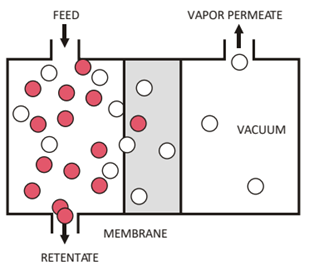
Tailored non-porous membranes which selectively absorb and permeate a specific component from a mixture to be separate.
Applying vacuum to the permeate side of membrane causes to preferentially absorb into the feed side of membrane, permeate through membrane thickness, and desorb from the permeate side of membrane a specific component in feed mixture into vapor shape.
Achieving the separation of the feed mixture by affinity difference between membrane material and permeants: a hydrophilic membrane will permeate water faster than organic in the permeation of organic/water mixture.
 The main applications of pervaporation/vapor permeation membrane processes are classified into three categories as follows:

Dehydration of organic liquid
Removal of VOCs from aqueous organic solutions
Separation of organic/organic mixture
 SepraTek™ Hollow Fiber Composite Membranes

Flowing of feed mixture inside of hollow fiber membrane
No channeling of feed in the module
No dead volume of feed mixture in flowing in module.
Low heat loss of feed mixture into the surrounding
Excellent pressure resistance (max. service pressure: 20 bar)
Excellent dimensional stability against organic solvent even at high temperature (max. service temperature: 110 °C)
 Membrane Module and Assembly
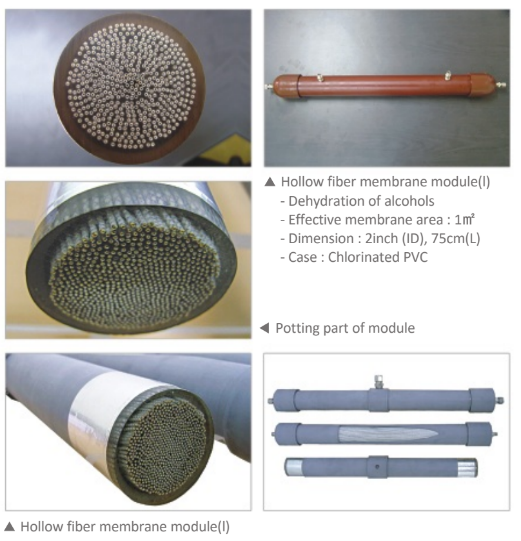
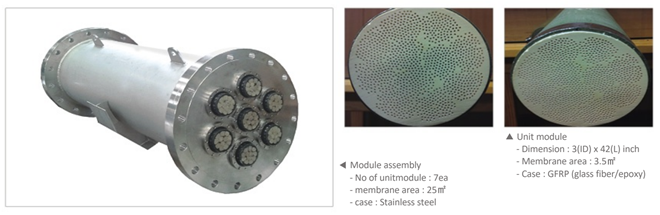
All hollow fiber membranes in the module are reinforced with polyester woven braid on the outside, and the feed liquid flows lumen side of hollow fiber and a vacuum is applied to the outside of the hollow fiber, i.e. on the shell side. In this case, the porous support layer and the braid layer act as an insulator, and moreover, vacuum applied at the outside of hollow fiber of the hollow fiber membrane retards heat transfer from the feed to its surrounding. As a result, the heat loss of the feed into the surrounding is very low, and thereby the case of membrane module would not be heated to a great extent by feed mixture of an elevated temperature. In addition, the braid layer with high porosity exists between the hollow fiber membranes and acts as a spacer, so that the vacuum applied is well transmitted to the outer surface of each hollow fiber and maintains a high degree of driving force. The materials of the module case are chemically resistant plastic, FRP and metal, etc., and the module potting resin uses epoxy resin with excellent heat resistance and chemical resistance.
In order to apply vacuum effectively to the permeate side of respective unit membrane module and to simplify piping in configuration of unit membrane modules, a number of unit modules are packed into a body 'module assembly' in fabricating a large scale of pervaporation system. The number of unit modules in a membrane assembly can be determined, depending on the hydraulic characteristics of feed liquid, the scale of pervaporation system, separation extent to be achieved, and so on.
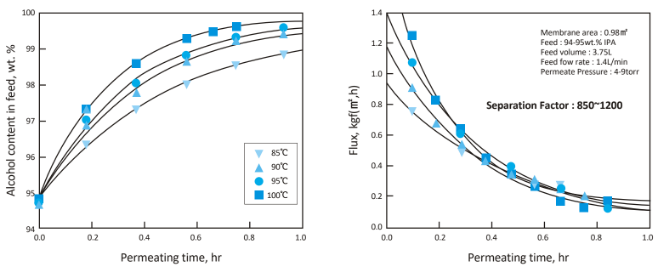
SepraTek™ Hollow Fiber Composite Membrane Performance
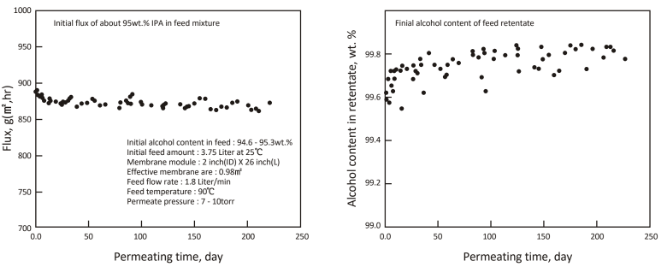
ong-term Membrane Performance of SepraTek™ Hollow Fiber
Composite Membrane
 SepraTek Hollow Fiber Membrane Module and System
SepraTek can design and supply permeable pervaporation/vapor permeation membrane separation systems in conjunction with or without the distillation process. This membrane separation system enables the separation of water/organic mixture without the high energy required to separate the mixture at the azeotrope point, such as liquid/liquid extraction and water washing. This SepraTek permeation evaporation/vapor permeation membrane separation process has the following features:

No introduction of additional chemicals - complete solvent dehydration by pervaporation membranes irrespective of azeotrope formation - no possibility of contamination.
A flexible process - a single unit can be designed to treat a large number of solvents.
A choice of batch or continuous pervaporation systems, or vapor pervaporation depending on the duty of separation
Vapor permeation process:
combined with evaporation process to recover solvents from feed liquid.
combined with distillation process to reduce capital costs and energy consumption.

Both on and off-site piloting available
Standard skid mounted units for fast delivery and installation and minimum hook-up time
Compact and easily scalable
Short payback time
 SepraTek™ Pervaporation/Vapor Permeation Membrane Systems
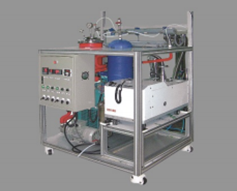
 Lab-scale Pervaporator
ㆍ Capacity: 5 L/h
ㆍ Membrane area: 1㎡
ㆍ Application: Dehydration of organics
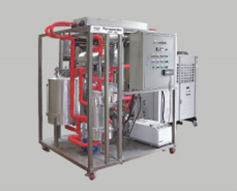
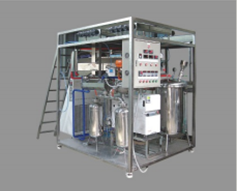
Pilot-scale Pervaporation system
ㆍ Capacity: 50 L/h
ㆍ Membrane area: 10㎡
ㆍ Application: Dehydration of organics
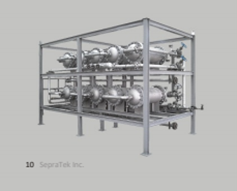
Commercial Pervaporation system
ㆍ Capacity: 200 L/h
ㆍ Membrane area: 50㎡
ㆍ Application: Dehydration of organics
Commercial Pervaporation system
ㆍ Capacity: 12 Ton/h
ㆍ Membrane area: 350㎡
ㆍ Application: Dehydration of jet oil
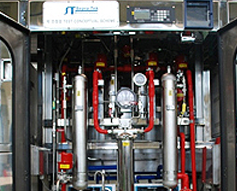
Pilot scaled Vapor permeation membrane system
ㆍ Volume: 5 NM/h
ㆍ Membrane area : 15㎡
ㆍ Application : Methylene chloride
 Specification of SepraTek™ PV/VP Hollow Fiber Membranes
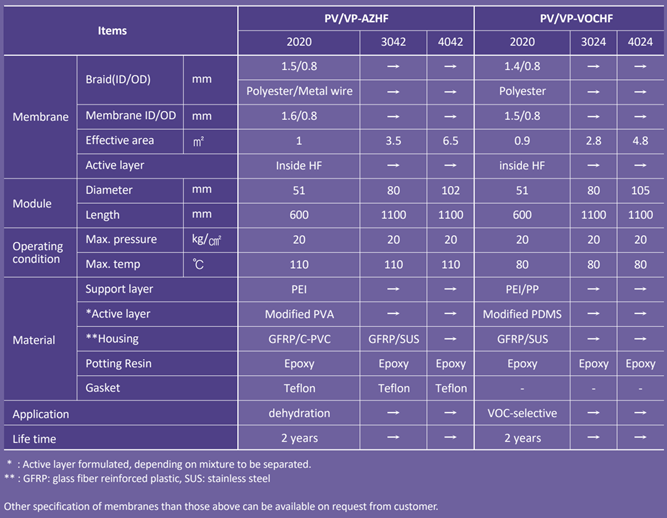
Active layer formulated, depending on mixture to be separated.
GFRP : glass fiber reinforced plastic, SUS: stainless steel
Other specification of membranes than those above can be available on request from customer.

ADDRESS
TEL
FAX