Products
Membranes & processes

SepraTek™ Membrane distillation process
The membrane distillation process is a membrane process that uses a porous hydrophobic membrane to effectively remove highly volatile components from a liquid mixture, and the permeation separation mechanism is as follows.
- The porous hydrophobic membrane is used to suppress the permeation of feed liquid (aqueous liquid) through pores, and allows the permeation of volatile components or water vapors.

The mixture to be separated consists of components with high and low boiling points
Since the vapor pressure (Pwater) of the highly volatile component (water) in the mixture (such as sea water) is greater than the vapor pressure (Phigh-bp) of the other components (salt, low volatile component), water is selectively evaporated and permeated through the pores of the membrane, and as a result, salt or low volatile components remain and separated.
Keeping the feed temperature high and/or the permeate pressure lower facilitates the evaporation of the low boiling point.

The membrane distillation process can be mainly classified into DCMD (Direct Contact MD), AGDCMD (Air Gap DCMD), VMD (Vacuum MD), etc., and is selected and used according to the characteristics of feed mixture and separation process.

 Feature of SepraTek™ membrane distillation membrane
SepraTek™ membrane distillation membrane is a porous PP hollow fiber membrane and is available in two types of membranes: hollow fiber membrane with braided spacer and hollow fiber without spacer. The PP hollow fiber membrane without spacer is available in a variety of diameters, pore sizes, and porosities, depending on its application area, and the PP hollow fiber membrane with spacer is made by braiding it with a high-strength polymer fiber on its outer surface. The braid acts as a spacer between the hollow fibers, giving room to transfer a vacuum to each fiber and thereby providing a path of water vapor through each hollow fiber. Therefore, the membrane distillation module can effectively remove the water vapor that has penetrated through each hollow fiber membrane. Membrane distillation separation system is designed and engineered through systematic simulation and a series of groundworks to maximize the membrane performance as well as the economical value of the membrane process.

 Feature of SepraTek™ membrane distillation process

Effective separation of volatiles (water in the desalination process) from the mixture by vacuum through the braid spacer.
Both on-site and off-site membrane systems available
A standard skid-mounted system which allows to be easily installed at a site.
 SepraTek™ Membrane distillation
SepraTek offers a complete set of optimized membrane distillation systems as a turn-key base to meet the requirements for the economics and separation performance, and the specific requests of its customers.
 Application

Desalination of sea water.
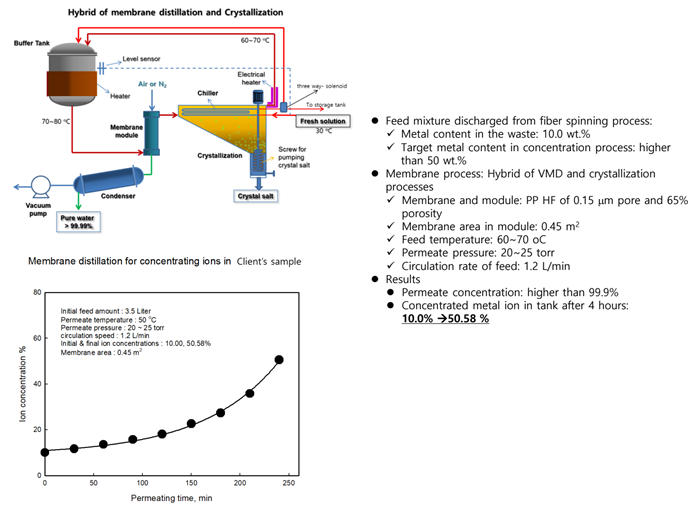
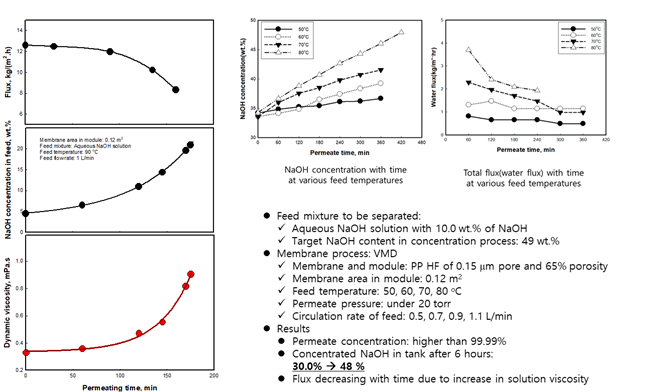
Concentration of inorganic and metal ions in aqueous solutions.
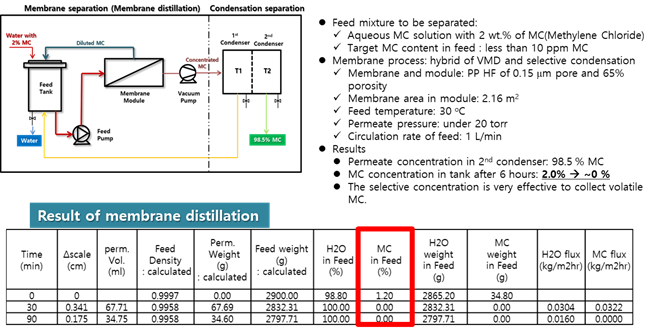
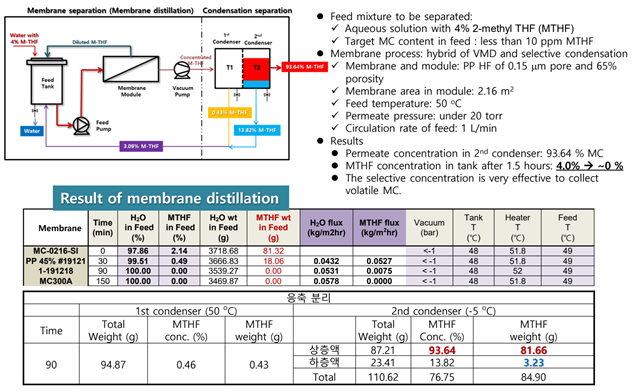
Separation and recovery of VOCs from wastewater.
Case Studies
 Case I: Separation of metal ions from waste stream
 Case II: Concentration of NaOH in aqueous solution
 Case III: Separation & recovery of Methylene Chloride (MC) from aqueous MC solution
 Case IV: Separation & recovery of 2-methyl THF (MTHF) from aqueous MC solution
 Specification of SepraTek™ membrane contactor/membrane distillation membrane modules


ADDRESS
TEL
FAX