Products
Membranes & processes

Adsorptive Permeation Membrane : APM
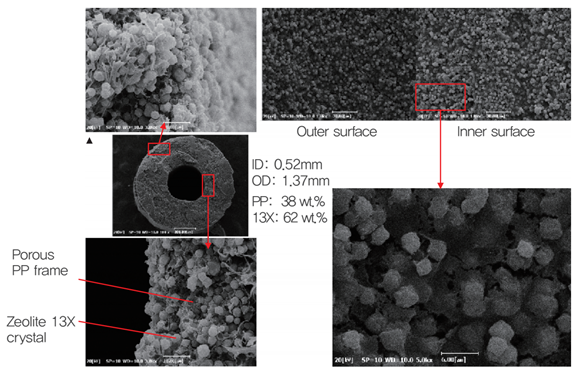
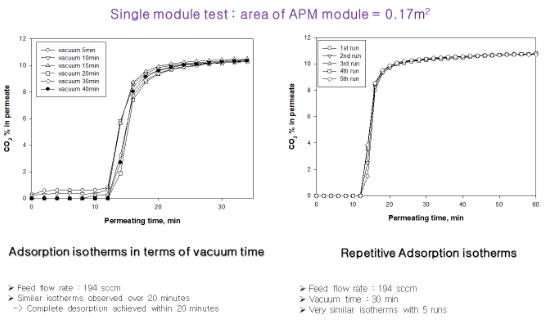
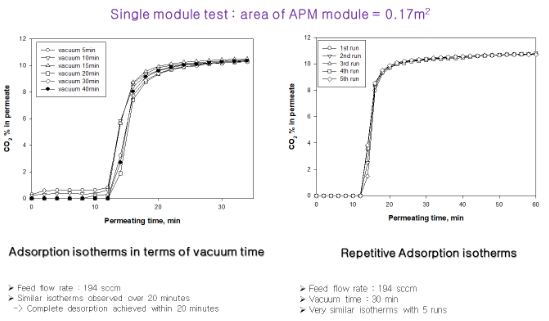
The adsorption permeation membrane (APM) consists of an adsorbent crystal and a porous polymer frame. Each adsorptive crystal particle is located inside a porous polymer hollow fiber lattice without being covered by the polymer at all, so that all surfaces of the crystal particles can be utilized for adsorption. Since separation via APM is achieved through selective adsorption of adsorbent crystal particles, this separation process is a hybrid process of adsorption and permeation. Compared to the general membrane separation process, the APM process can quickly and effectively separate the gas mixture by selective adsorption, and after each crystal particle has been adsorbed and saturated, APM can regenerate the crystal particles by simply applying a vacuum to both the inside and outside of the hollow fiber by easily removing the adsorbed gas on the particle surface

Mechanism of separation in APM
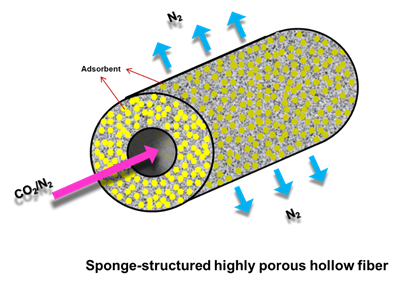
When the gas mixture (N2/CO2) to be separated passes through the thickness of the porous hollow fiber membrane as shown in the figure below, the crystal particles having an affinity towards a component (CO2) selectively adsorbs CO2 on their surface, while the non-adsorbent component (N2) passes through the porous membrane, and thereby separation occurs. As mentioned earlier, the surface of all crystal particles is not covered by the polymer membrane material, so maximum adsorption separation performance is achieved by maximizing contact with passing gases. The highly porous structure of the APM allows the separation of gas mixtures at feed pressures as low as negligible as a result of the pressure drop throughout the APM, and makes it easy to regenerate APMs saturated with selectively adsorbed gaseous components.

APM Separation process
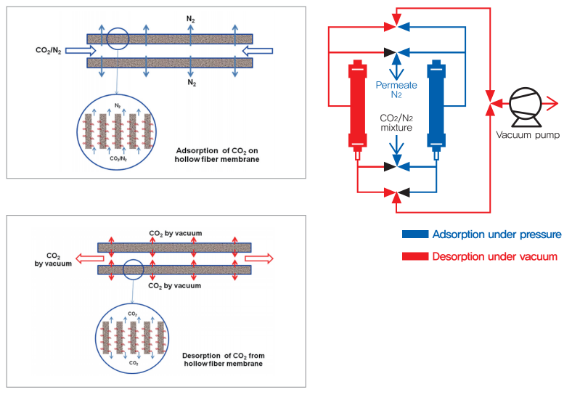
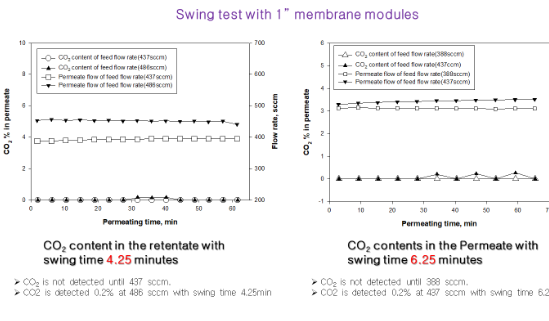
The APM separation process consists of two processes, namely adsorption process and desorption process. In the adsorption process, when the gas mixture penetrates the porous APM membrane, separation by the selective adsorption occurs, and when a vacuum is applied at both the inside and the outside of the hollow fiber to regenerate the adsorption saturated membrane, the gas adsorbed on the crystal particles is desorbed and the APM membrane is regenerated. In this way, if the adsorption and desorption processes are alternately carried out at regular intervals on two or more APM membrane modules, that is, the gas mixture can be continuously adsorbed and separated by the swing process.

ADDRESS
TEL
FAX